


21 October 2026
Third group of cinereous vultures released into the wild in the Douro International region to boost the cross-border colony
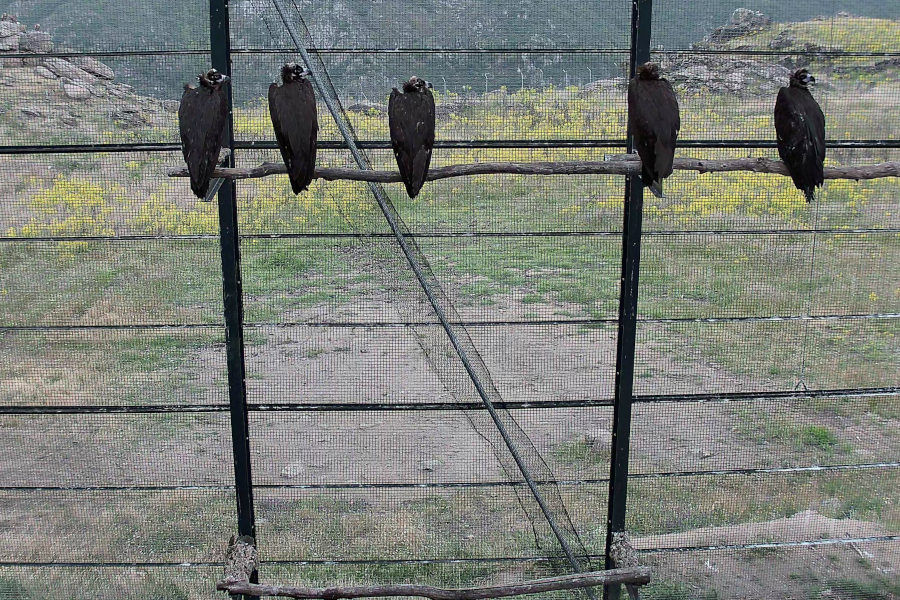
The third group of cinereous vultures from the LIFE Aegypius Return acclimatisation programme: four males and one female. Photo: Palombar.
The third group of cinereous vultures to take part in the acclimatisation programme implemented by the LIFE Aegypius Return project was released into the wild on 6 October in the Douro International Natural Park (PNDI). The enclosure housing the five cinereous vultures that were returned to the wild was opened during a session as part of the International Workshop on ‘Vulture Conservation, Monitoring and Threat Detection’, which took place between 6 and 9 October in Miranda do Douro.
The workshop brought together various organisations, experts and specialists involved in the conservation of European vulture species
The international workshop ‘Vulture Conservation, Monitoring and Threat Detection’ was organised by the ERF – European Ranger Federation, in partnership with the VCF – Vulture Conservation Foundation, Palombar – Conservation of Nature and Rural Heritage – and the ICNF – Institute for Nature Conservation and Forests, with vital support from the Union of Parishes of Lagoaça and Fornos, in the municipality of Freixo de Espada à Cinta, the Municipality of Miranda do Douro, as well as the Continente Producers’ Club and Movhera.

The international workshop ‘Vulture Conservation, Monitoring and Threat Detection’ addressed a number of key issues relating to the conservation of European vultures. Photo: Iván Gutiérrez/Palombar.

The event was very well attended and involved a wide range of local stakeholders. Photo: Iván Gutiérrez/Palombar.
This event brought together national and international experts, researchers, nature conservation specialists, nature rangers and representatives from various public and private organisations with responsibilities for the management and conservation of European vulture species.
The main aim of the workshop was to enhance participants’ technical skills in the areas of conservation, monitoring and the identification of threats to vulture populations in Europe, whilst also fostering international cooperation, the sharing of scientific knowledge and the dissemination of best practices for the management and protection of these species.

The workshop strengthened international cooperation for the conservation of vulture species found in Europe. Photo: Iván Gutiérrez/Palombar.
Where did the cinereous vultures released back into the wild come from?
The third group of cinereous vultures (Aegypius monachus) arrived at the acclimatisation station at the PNDI in March this year, comprising four males and one female. Of these, four are juveniles that had been rescued from the wild showing signs of weakness and malnutrition, from various locations in the Central region: Escalhão (Figueira de Castelo Rodrigo), Torredeita (Viseu), Santa Comba (Seia) and Guarda, in September and October 2025. The fifth is the young Pousio, born in the Vidigueira colony in 2024, who, whilst taking his first flights from the nest, was shot with a shotgun whilst perched, leaving him with more than 22 pellets and projectile fragments in his legs and body. Since being shot, Pousio has been undergoing a delicate, slow and complex recovery process, and his stay at the acclimatisation station was yet another great opportunity for him to return to full freedom.
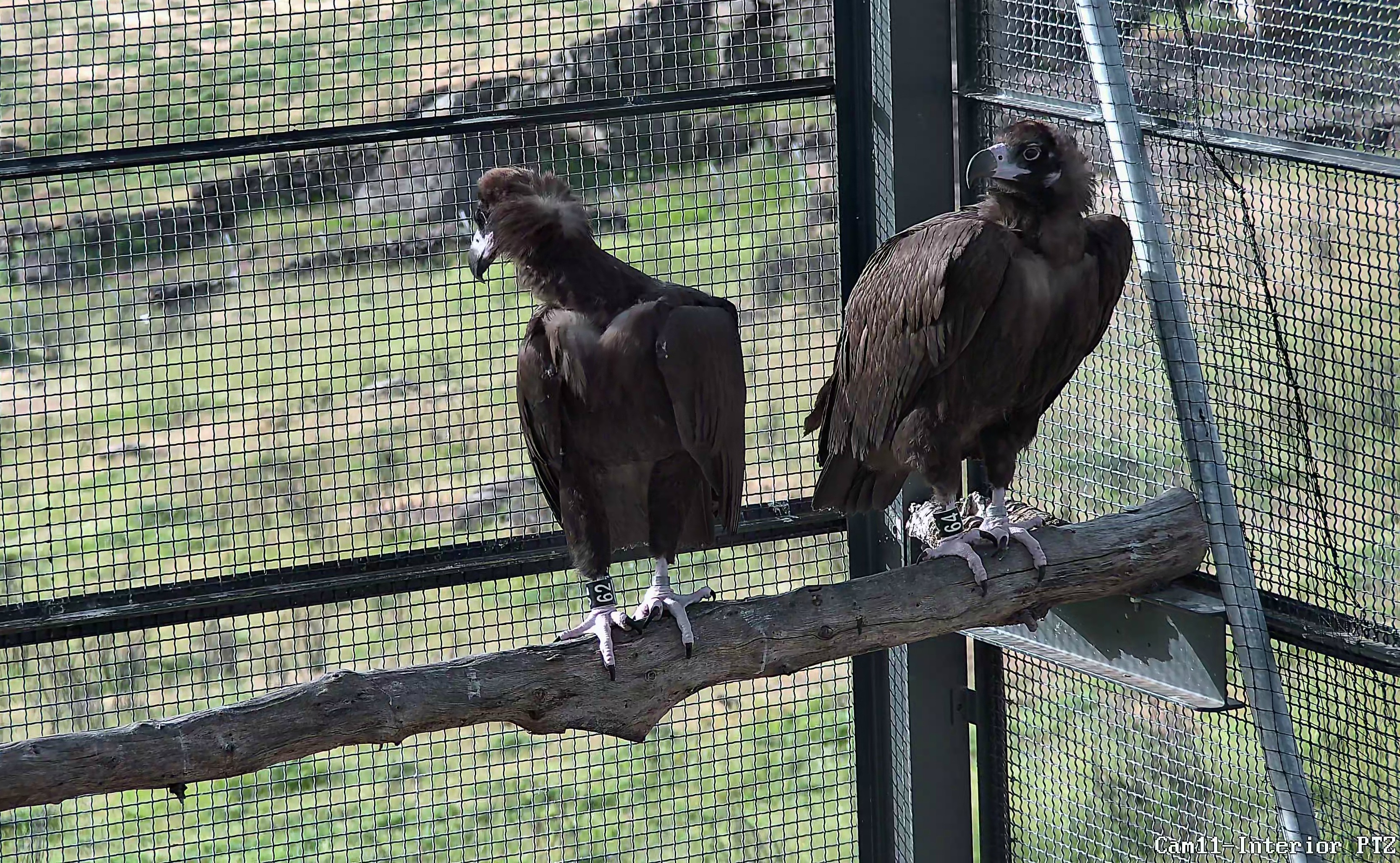
Two cinereous vultures from the third group to join the acclimatisation programme of the LIFE Aegypius Return project. Photo: Palombar.
The five cinereous vultures had previously undergone a period of rehabilitation at various wildlife recovery centres before being transferred to the station, namely at CRAS-HV-UTAD – the Wildlife Recovery Centre at the Veterinary Hospital of the University of Trás-os-Montes and Alto Douro, at CERVAS – Centre for Ecology, Recovery and Monitoring of Wild Animals – and at LxCRAS – Lisbon Wildlife Recovery Centre.
Veterinary check-ups (before and after), collection of biological samples and GPS tagging
Both when they were admitted to the centre in March and when they were being prepared for release on 30 September, all the cinereous vultures had their health carefully assessed by vets from CRAS-HV-UTAD, who examined each bird’s physical condition and collected biological samples to be used in conservation studies of the species.

All the cinereous vultures had their health carefully assessed by vets from CRAS-HV-UTAD. Photo: Uliana Maria de Castro/Palombar.
The birds, which had already been ringed, were also fitted with GPS/GSM devices by the team from the Instituto Mixto de Investigación en Biodiversidad (IMIB, CSIC-University of Oviedo-Principality of Asturias), in Spain, which is collaborating on the project. This equipment is essential for ensuring the remote and continuous monitoring of the vultures and the collection of data vital for promoting better protection, conservation and management measures.

Biological samples were also collected, which will be used in studies on the conservation of the species. Photo: Uliana Maria de Castro/Palombar.
Where are the cinereous vultures now that they are fully free?
Following the opening of the acclimatisation station, and now back in the wild, all the cinereous vultures initially remained in the vicinity of the facility, but gradually began to make their first exploratory flights in the Douro International Natural Park area.
Pousio initially caused some concern as he displayed behaviour patterns that might have indicated difficulty in adapting; however, after a few days, he appears to have overcome these initial setbacks and, by all accounts, is already showing signs of thriving in the open air.

Map showing the movements of one of the cinereous vultures following its first few days exploring the PNDI territory. Image: Palombar/VCF.
Unfortunately, however, it is not all good news. One of the cinereous vultures died a few days after leaving the station. Project staff are investigating what may have happened; however, it appears highly likely that it was preyed by another wild animal.
Acclimatisation programme: a pioneering method with proven results
The LIFE Aegypius Return project has implemented a pioneering acclimatisation programme in Portugal to restore Europe’s westernmost cinereous vulture population – which is also the most isolated and fragile in Portugal. This programme involves placing juvenile cinereous vultures rescued from the wild into a large facility situated within the PNDI itself, managed by Palombar on land owned by Faia Brava – Nature Conservation Association, so that they can undergo a process of socialisation amongst their peers, adaptation to the territory and a slow, phased release, thereby strengthening their attachment to the area. This method has already proven its effectiveness, having contributed significantly to the growth of the population of the cross-border colony in the International Douro region.

The acclimatisation programme has been a success and has already enabled four cinereous vultures to become established in the country’s most vulnerable and isolated colony. Photo: Alexandre da Silva.
There are currently ten breeding pairs of cinereous vultures in this colony, five on the Portuguese side and five on the Spanish side, in the Arribes del Duero Natural Park. In 2019, in the PNDI, there were only two breeding pairs. Not counting the group of cinereous vultures now released back into the wild, four individuals from the acclimatisation station have already established themselves in the area, helping to significantly boost this vulnerable population.
The LIFE Aegypus Return project operates within designated areas of the Natura 2000 Network. In northern Portugal, activities are centred on the Douro Internacional and Vale do Águeda Special Protection Area (ZPE DIVA), which forms part of this Network and encompasses almost the entire territory of the PNDI.
A name for each one, because each is unique and matters: involving the younger generations in vulture conservation
With the exception of Pousio, who has already been «baptised», the remaining three cinereous vultures will be given names chosen by pupils from schools in the municipality of Freixo de Espada à Cinta, where Palombar’s Environmental Education team will organise, at the end of October, an environmental awareness activity focusing on this third group of cinereous vultures released back into the wild. We believe that the involvement of the younger generations is essential to ensuring a promising present and future for all species of vultures that form part of the region’s identity, fulfil a vital ecological role and share the landscape with us.

A flock of griffon vultures (Gyps fulvus) flying over the acclimatisation station, where the five cinereous vultures released back into the wild had been for several months. The PNDI is a vital area for the conservation of all species of European vultures. Photo: Uliana Maria de Castro/Palombar.
The LIFE Aegypius Return project is co-financed by the European Union’s LIFE programme. Its success depends on the involvement of all the relevant stakeholders, and the collaboration of the partners: the Vulture Conservation Foundation (VCF), the coordinating beneficiary, and the local partners Palombar – Conservação da Natureza e do Património Rural (co-funded by Viridia - Conservation in Action, Lightsource bp and MAVA - Fondation pour la Nature), Herdade da Contenda, Sociedade Portuguesa para o Estudo das Aves, Liga para a Protecção da Natureza, Associação Transumância e Natureza, Fundación Naturaleza y Hombre, Guarda Nacional Republicana and Associação Nacional de Proprietários Rurais Gestão Cinegética e Biodiversidade.