


26 January 2026
Water Bridges project field trip put the school community on the trail of the European pond turtle
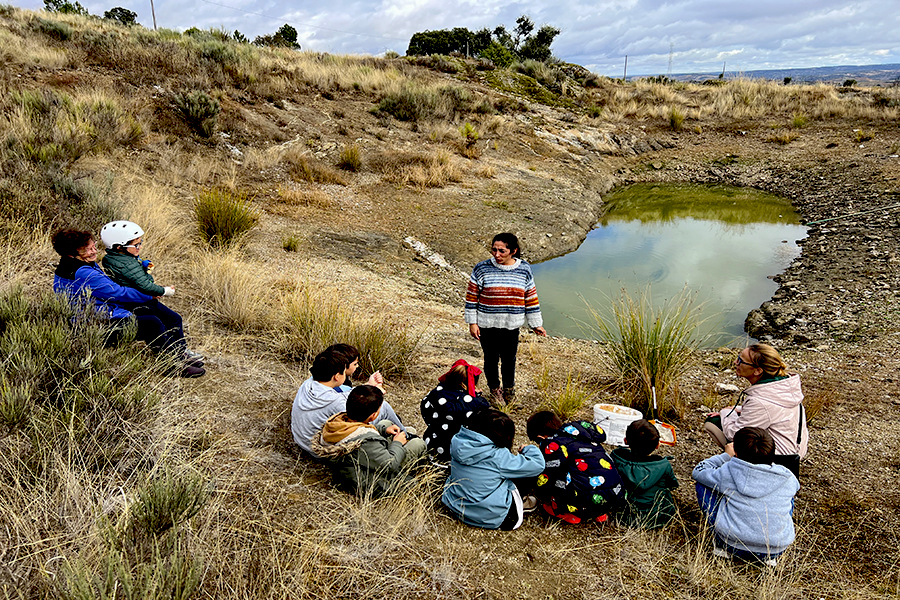
Visit to a local pond, one of the typical habitats of the European pond turtle. Photo: Palombar.
The field trip ‘Water Bridges - Uniting Generations for the Conservation of the European pond turtle’, organised by Palombar as part of the Water Bridges project, took the school community of the 1st Cycle of the Educational Centre in Bemposta, which is part of the Mogadouro School Group, to discover a very special and endangered reptile: the European pond turtle (Emys orbicularis).
The activity, held at the end of October 2025, consisted of an interpretive walk between the school building and a local pond, one of the types of habitat where this species occurs. Nine students, one teacher and one teaching assistant took part. Guided by environmental education specialist Sara Freire and biologist Pedro Alves, both from Palombar, they showed great interest and curiosity in finding out more about this reptile, which is native to the region and one of the most endangered in Europe.

Understand to better conserve: feel and learn
With a focus on a practical and participatory approach, while still in the classroom, students had the unique opportunity to see up close a Mediterranean pond turtle (Mauremys leprosa) - another native turtle species - which has a special history. Raised in captivity, it was handed over to Palombar following an awareness campaign, and was later transferred to the Wildlife Recovery Centre at the Veterinary Hospital of the University of Trás-os-Montes and Alto Douro (CRAS-HV-UTAD), where it is undergoing quarantine and (re)adaptation to wildlife before being returned to nature in the spring of this year.
Seeing that reptile, which carries with it millions of years of evolutionary history, was enriching and made everyone want to know more about these species that have stood the test of time and should continue to be among us.


Direct contact with the territory revealed an environmental reality that justifies the importance of projects such as Water Bridges, whose main objective is to conserve and protect the European pond turtle and its habitat.
During the walk and at the pond, the participants did not find any species of turtle, but rather a lot of waste that degrades the environment and affects the occurrence of these creatures, which reinforces the importance of implementing measures to restore their habitats. At the site, they explored the surrounding environment, learning about the ecological dynamics that rule the vital connection between fauna, flora, humans and the environment.

The activity, held at the end of October 2025, consisted of an interpretive walk between the school building and a local pond, one of the types of habitat where this species occurs. Nine students, one teacher and one teaching assistant took part. Guided by environmental education specialist Sara Freire and biologist Pedro Alves, both from Palombar, they showed great interest and curiosity in finding out more about this reptile, which is native to the region and one of the most endangered in Europe.
Interpretive walk through the landscape. Photo: Palombar.
Understand to better conserve: feel and learn
With a focus on a practical and participatory approach, while still in the classroom, students had the unique opportunity to see up close a Mediterranean pond turtle (Mauremys leprosa) - another native turtle species - which has a special history. Raised in captivity, it was handed over to Palombar following an awareness campaign, and was later transferred to the Wildlife Recovery Centre at the Veterinary Hospital of the University of Trás-os-Montes and Alto Douro (CRAS-HV-UTAD), where it is undergoing quarantine and (re)adaptation to wildlife before being returned to nature in the spring of this year.
Seeing that reptile, which carries with it millions of years of evolutionary history, was enriching and made everyone want to know more about these species that have stood the test of time and should continue to be among us.
Raised in captivity for years, those who cared for him became attached to him and recognised the importance of returning this reptile to its natural habitat, handing him over to Palombar. Photo: Pedro Alves/Palombar.
Observing the Mediterranean pond turtle in the classroom sparked great interest and curiosity among the children. Photo: Palombar.

The power of direct observation was reflected in the learning and understanding of the information shared. Photo: Palombar.
Direct contact with the territory revealed an environmental reality that justifies the importance of projects such as Water Bridges, whose main objective is to conserve and protect the European pond turtle and its habitat.
During the walk and at the pond, the participants did not find any species of turtle, but rather a lot of waste that degrades the environment and affects the occurrence of these creatures, which reinforces the importance of implementing measures to restore their habitats. At the site, they explored the surrounding environment, learning about the ecological dynamics that rule the vital connection between fauna, flora, humans and the environment.
Students explore native flora. Photo: Palombar.
We discussed the biodiversity of wetlands, with a focus on the European pond turtle and its ecological importance. We explored techniques for monitoring these reptile species and reflected on the impacts of climate change and human activities on their conservation, as well as mitigation measures and strategies we can adopt to ensure that these ancient reptiles continue to be part of a biodiverse landscape that benefits us all.